Something's wrong with your plants — and you're not sure what.

Maybe the leaves are turning yellow. Maybe the plant looks wilted even though you just watered it. Maybe there are brown spots, holes in leaves, or the whole thing just stopped growing.
This happens to every gardener. Even experienced ones.
The good news: most common gardening problems have straightforward causes — and once you know what to look for, they're usually fixable. This guide covers the issues beginners run into most often, what causes them, and what to actually do about them.
Quick Answer
Affiliate Disclosure: This article contains affiliate links. If you make a purchase through one of them, we may earn a small commission at no extra cost to you. We only recommend products we genuinely believe will help your garden thrive.
The most common gardening problems are:
- Overwatering — soggy soil suffocates roots
- Underwatering — plants wilt and crisp up
- Too little sunlight — plants grow leggy and weak
- Nutrient deficiencies — yellowing, spotting, poor growth
- Pests — aphids, spider mites, caterpillars
- Disease — fungal spots, powdery mildew, blight
- Wrong soil — poor drainage or compaction
Most problems can be diagnosed by looking at your leaves, checking your soil moisture, and considering your light conditions.

Yellow leaves are the most common sign of trouble — usually caused by watering issues or nutrient deficiency.
Why Diagnosing Problems Early Matters
Gardening problems rarely fix themselves. A small pest infestation becomes a major one. A slight nutrient deficiency becomes stunted, unproductive plants. A bit of root rot spreads until the whole plant is gone.
The earlier you catch an issue, the easier it is to fix — and the less damage your harvest takes.
For beginners especially, knowing what's normal vs. what's a problem is one of the most valuable skills you can build.
The Most Common Gardening Problems — Diagnosed
Problem 1: Yellow Leaves
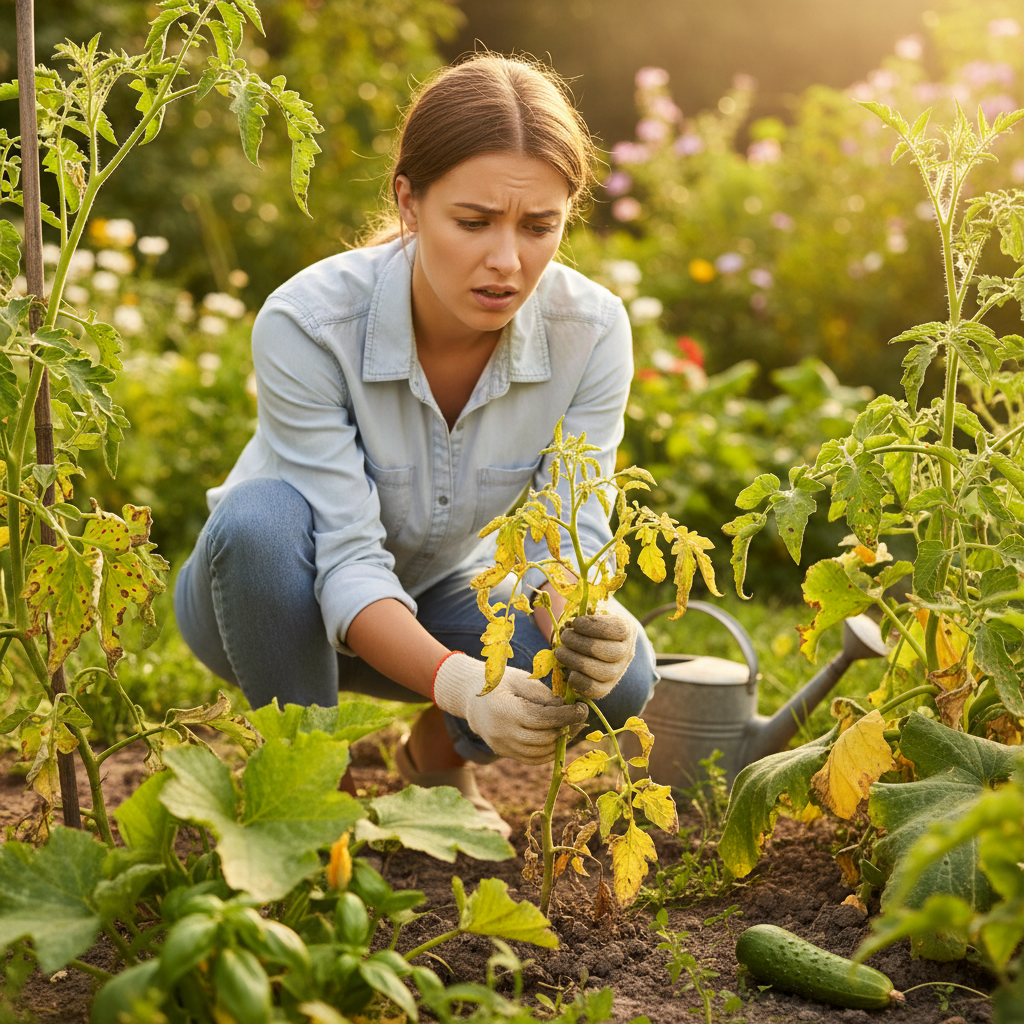
Yellow leaves are the most common complaint in gardening — and they have multiple possible causes, which makes them tricky.
Possible causes:
- Overwatering — yellowing starts with lower leaves, soil feels constantly wet
- Underwatering — leaves yellow and feel dry or papery
- Nitrogen deficiency — pale yellow spreading from older leaves upward
- Natural aging — some lower leaf yellowing is completely normal
- Root rot — yellowing combined with wilting despite wet soil
- Too little light — pale, washed-out yellowing across all leaves
How to diagnose: Check the soil moisture first. Then look at which leaves are yellowing (bottom vs. top) and whether it's happening fast or slowly.
Fix it:
- Wet soil + yellow leaves = let it dry out, check for root rot
- Dry soil + yellow leaves = water more consistently
- Normal moisture + yellowing = start a balanced fertilizer

Wilting is usually a sign of underwatering — water deeply and check soil moisture daily during hot weather.
Problem 2: Wilting Plants
Wilting is alarming to look at, but it doesn't always mean your plant is dying.
Possible causes:
- Underwatering — the most obvious cause. Leaves droop and feel dry.
- Overwatering / root rot — counterintuitive, but roots that have rotted can't deliver water even when soil is wet
- Heat stress — plants may wilt briefly in afternoon heat, then recover on their own by evening
- Transplant shock — newly moved plants often wilt for a few days while adjusting
- Root-bound plants — a plant too large for its pot can't access enough water
Fix it:
- Water thoroughly if soil is dry
- If soil is wet and the plant is wilting, reduce watering and check roots for brown, mushy rot
- Heat wilt usually fixes itself by morning — no action needed
- Repot if the plant is severely root-bound
Problem 3: Brown Leaf Tips or Edges
Brown tips are usually a sign of stress rather than disease.
Possible causes:
- Inconsistent watering — soil drying out between waterings
- Low humidity — especially for indoor plants
- Fertilizer burn — too much fertilizer salts building up in the soil
- Fluoride or chlorine in tap water — sensitive plants can react to tap water chemicals
Fix it:
- Water more consistently
- Flush the soil with clean water if over-fertilized
- For sensitive plants, let tap water sit overnight before using, or use filtered water
Problem 4: Holes in Leaves
Holes in leaves almost always mean something is eating your plants.
Common culprits:
- Caterpillars / hornworms — large ragged holes, often on tomatoes and peppers
- Slugs and snails — irregular holes, especially on lower leaves, worse after rain
- Flea beetles — tiny round holes scattered across leaves
- Earwigs — jagged holes, mostly at night
Fix it:
- Inspect leaves top and bottom for insects or eggs
- Hand-pick caterpillars and hornworms
- Apply diatomaceous earth around the base of plants for slugs
- Use row covers to prevent flying pests
- For serious infestations, a spray of diluted neem oil works on many soft-bodied pests

A 2-3 inch layer of mulch solves several common garden problems at once — heat, drought, and weeds.
Problem 5: White Powder on Leaves (Powdery Mildew)
Powdery mildew looks exactly like it sounds — a white or grey dusty coating on leaf surfaces. It's a fungal disease and one of the most common problems in vegetable gardens.
Why it happens:
- Poor air circulation
- Wet leaves (watering from above)
- Warm days and cool nights
Fix it:
- Remove and dispose of heavily affected leaves
- Spray affected plants with a diluted solution of baking soda and water (1 tsp baking soda per quart of water)
- Improve air circulation by pruning crowded growth
- Water at the base of plants, not on leaves
- For severe cases, a copper fungicide or neem oil spray helps
Problem 6: Aphids and Pest Infestations
Aphids are tiny soft-bodied insects (often green, black, or white) that cluster on new growth and suck sap from plants. They reproduce incredibly fast.
Signs of aphids:
- Clusters of tiny bugs on stems and leaf undersides
- Sticky residue (called honeydew) on leaves
- Curling or puckered new leaves
Fix it:
- Blast them off with a strong stream of water
- Spray with diluted neem oil or insecticidal soap
- Introduce beneficial insects — ladybugs eat aphids voraciously
- Check plants weekly so populations don't explode
Other common pests to know:
- Spider mites — tiny dots on leaves, fine webbing underneath; thrive in hot, dry conditions
- Whiteflies — cloud of white insects when disturbed; use yellow sticky traps
- Fungus gnats — tiny flies in potting soil; caused by consistently wet soil
Problem 7: Stunted Growth or No Fruit
Plants that grow slowly, stay small, or flower but never produce fruit are frustrating.
Possible causes:
- Not enough sunlight — fruiting crops need 6–8 hours minimum
- Nutrient deficiency — especially phosphorus, which drives root and flower development
- Poor pollination — indoor plants and isolated outdoor plants may not get enough bee visits
- Overcrowding — plants competing for root space, water, and nutrients
- Temperature stress — too hot or too cold for the plant's preference
Fix it:
- Move containers to a sunnier spot
- Feed with a fertilizer higher in phosphorus once flowering begins
- Hand-pollinate indoor tomatoes and peppers by gently shaking flowers or using a small brush
- Thin overcrowded seedlings

Most common garden problems are fixable — and a recovered garden often grows stronger than before.
Step-by-Step: How to Diagnose Any Plant Problem
- Look at the whole plant first. Is just one part affected or the whole plant? New growth or old growth?
- Check the soil. Stick your finger 2 inches in. Wet, dry, or just right?
- Inspect the leaves. Top and bottom. Look for insects, eggs, spots, webbing, or powder.
- Consider your conditions. How much light? What's the temperature? When did you last fertilize?
- Narrow it down. Match your symptoms to the most likely cause above.
- Make one change at a time. If you change watering and fertilizer simultaneously, you won't know which fixed it.
Recommended Supplies and Tools
Having the right tools makes diagnosing and treating problems much easier:
- Moisture meter — eliminates guesswork on watering
- Soil pH test kit — know your soil before planting
- Neem oil concentrate — handles pests and some fungal issues
- Diatomaceous earth — safe mechanical pest control
- Balanced liquid fertilizer — quick fix for nutrient deficiencies
- Copper fungicide — for powdery mildew and other fungal diseases
You don't need all of these at once. Start with a moisture meter and some neem oil — those two tools alone solve the majority of beginner problems.
Recommended Products
Looking for the right gear to get started? We've curated our top picks for sustainable vegetable gardening — from raised beds and grow lights to seed-starting kits and organic fertilizers — on our Recommended Products page.
Ready to Start?
If you're ready to gear up, check out our recommended raised beds and grow lights on Amazon — beginner-approved and built to last.
Ready to Start?
If you're ready to gear up, check out our recommended raised beds and grow lights on Amazon — beginner-approved and built to last.
Ready to Start?
If you're ready to gear up, check out our recommended raised beds and grow lights on Amazon — beginner-approved and built to last.
Ready to Start?
If you're ready to gear up, check out our recommended raised beds and grow lights on Amazon — beginner-approved and built to last.
Final Thoughts
Every gardening problem is a signal. Yellow leaves, holes, wilting, mildew — they're all your plants communicating something. The more you learn to read those signals, the faster you'll catch problems and the better your garden will perform.
Start simple: check your water, check your light, check for bugs. Most of the time, the answer is found in one of those three places.
Gardening gets easier with every season. Even the mistakes teach you something useful.